
The friend raft
Eating food together while children run wild in someone’s small apartment turned out to be my go-to survival strategy of 2025.

Last year, at the beginning of March, one of my kids had a seizure. He’s okay now, but there were many long minutes where I wasn’t sure he would be.
Two days after the seizure, I hosted a Zoom event with a visiting writer. We’d never met before, but she was kind when I told her what had happened, offering to take the lead and let me stumble through without saying too much. The actual event is a blank spot in my memory now. I can’t tell you a single thing we discussed, though I can recall the specific frequency of the fear that was still humming through my body. I continued to stumble through for the rest of the semester: teaching in a state of half-distraction, covering for my TAs (several of whom seemed to be having their own crises), and planning a wedding, all while sleeping most nights on the couch outside my kids’ room, because my own bed felt too far away.
For months after, I kept thinking I would write about it all, not about the events of the seizure itself, which still feel too private and tender to make public, but about everything else that happened that day: how our friends showed up for us, how it changed how I thought about what it means to live in community. But I never managed to. I think I was still stumbling, still figuring out how to live with a new kind of risk.
This is the thing about being alive, I guess. You go about your days and then, out of nowhere, something happens that reorganizes how you understand what it means to be human. The seizure was like that for me: a reminder that loving someone isn’t enough to keep them safe.
On the day of the seizure, we’d been planning to have brunch at our friends’ house down the block. We’d gone to their place for a meal once or twice before, but it still felt like a big deal. Someone wanted us—me, Mark, and two three year olds—to come over to their un-childproofed home and eat food with them. I’d gotten used to the idea that our family was too curious, too chaotic, too messy for most people. I still feel this sometimes, but these particular friends made our chaos feel welcome. I could tell that they didn’t just tolerate my kids, but delighted in them.
So, when Mark and our sick kid went to the hospital in the ambulance, I took our other kid down the block for brunch. And then I left him there and I went to the hospital too. Actually, what happened was that my friends forced me to leave him there and go to the hospital. I was still in shock and they could see that the hospital was the place I needed to be, so they pushed me out the door and promised me that everything would be fine.
For the rest of the day, between updates from the doctors, I got updates from brunch: my kid eating a massive plate of waffles and bacon, my kid doing a puzzle while a cat lounged on top of the pieces, my kid cracking up at Winnie the Pooh while our friend dozed next to him on the couch. I was able to be totally present at the hospital, never worrying about whether an unplanned afternoon of childcare was a burden to our friends. I never worried about whether my kid felt anything other than comfortable at their home, either. And I was enormously grateful for all of it.
After this, having friends around—people who knew and loved my children and whom my children knew and loved in return—began to seem more like a need-to-have-kind-of-thing than a nice-to-have-kind-of-thing, a matter of survival really. I had just written an article for the Narwahl about how, in a crisis, your neighbors are your first responders. I was writing about climate emergencies, but somehow I failed to consider that this idea might apply to every other kind of crisis, too—and there are many. But here were our neighbors, showing up for us. And I wanted more: more neighbors, more meals, more kids running around spilling juice. I felt ravenous for it.
In the months that followed, I made every possible effort to be with people, usually around a table, sharing a meal. We invited friends into our home and we said yes to nearly every invitation we received. The more we did this, the easier it became: I got more comfortable showing up to someone else’s house last minute or empty handed. I stopped worrying so much about my two, tiny human tornados, who still cannot sit through an entire meal.
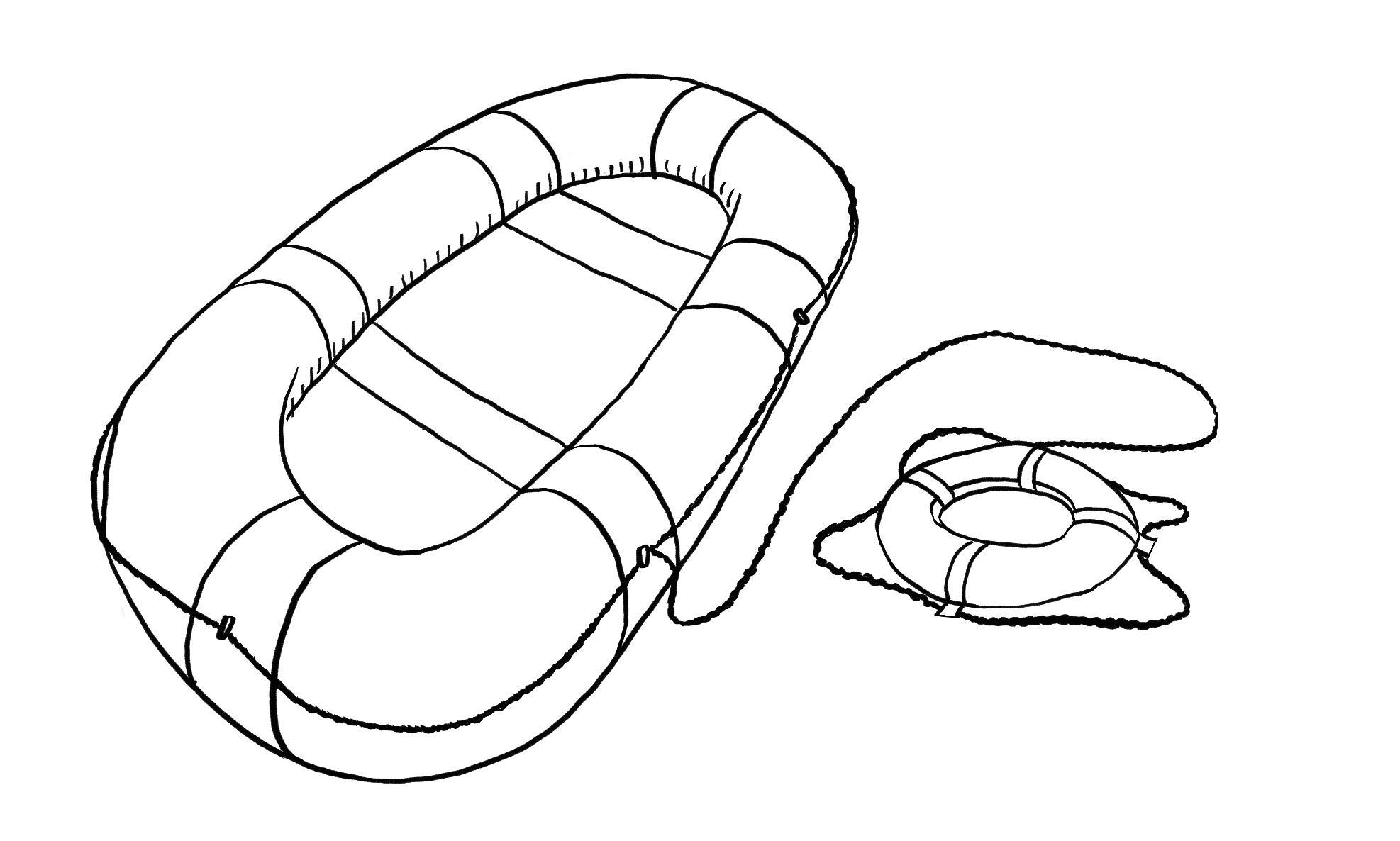
In the fall, several of my friends found themselves solo parenting for days or weeks at a time, so we started being more strategic in our gatherings: taking turns having each other for dinner when someone’s partner was away, keeping one another afloat when things were hard and care stretched thin. My friend Liz started calling it “the friend raft.” Because the goal wasn’t to entertain or impress, but to make it a little easier to get through the week, these meals were imperfect, dinners cobbled together with a mix of dishes and flavors, people eating in shifts or while sitting on the couch or the floor. No one cleaned their house before dinner, and everyone tried to pitch in after.
Our friends got used to the sight of our silverfish traps, of our staircase cluttered with shoes and bike helmets. Our kids got very into “welcoming” people, which involves standing near the elevator and jumping up and down, screeching with delight when the doors finally open. We tracked playground sand into people’s houses and we broke their toys. And it was fine. I could trust that it was fine because there were always more dinners on the calendar.
By Thanksgiving, it felt like no big deal to have nineteen people eating a meal in the living room of our 1000 sqft apartment. I made a 20lb turkey and our friends brought side dishes and pie. And, in what proved to be a brilliant idea, they brought their own plates and silverware to cut down on the dishwashing. It was loud and crowded and my kids—who love to eat on our laps whenever possible—decided that actually they’d prefer to eat this meal on our neighbors’ laps. I could feel that something had shifted by then. In me but also in the group. The friend raft was floating—in a way that felt genuinely effortless. These are people I have known and loved for years, but I began to think of them more like an extension of our little nuclear family: people I can weather a crisis with whenever the next one comes, which it will.
I can’t take all the credit for this shift. I happen to be surrounded by people (most of whom, like me, do not have extended family nearby) who are interested in this very messy, imperfect and joyful way of showing up for each other. But I did work at it. It required learning to ignore the voice in my head that worried my family was too much for other people, or that a messy home was not appropriate for guests, or that I needed to have something fancy to contribute or serve, that takeout pizza was not good enough for guests. But now, here I am, going into 2026 without resolutions but with a lot of gratitude that my life is shaped by an infrastructure of care that was previously unimaginable to me.
A couple weeks ago, a friend was sick—like really sick—so I sent a text, asking if I could take her kid so she could go to the ER the next morning. This was such a pleasure for me: to be able to make this offer, for her to feel comfortable saying yes. When the doctor decided to admit my friend to the hospital, I turned to the group chat. It wasn’t just that everyone wanted to help, it was that our lives were, by this point, integrated enough that we knew how to help. We figured out childcare so her partner could be at the hospital. We found colleagues to cover for her at work. One friend happened to know a specialist who could offer medical advice, which ended up being crucial for the diagnosis. I marveled as I watched this process unfold, at how easy and intuitive it now feels to show up for each other.
It is true that loving someone is not enough to keep them safe, but love does have some protective value. And, in my experience, that value (and the love itself) is amplified by this kind of everyday, ordinary kinship, the kind that happens around a table, over a meal, in one gathering after another. Writer and political organizer Amanda Litman called having friends over for dinner every week the most political thing she did in 2025: “To get to know your neighbors and build deeper more meaningful relationships is what enables us to not just survive this era but possibly even thrive in and after it.”
For many people, 2025 has been a year of reckoning with all the things that will not keep a person safe. Being white or middle class, being a citizen of the nation in which you live, being a conservative person in a red state or a liberal person in a blue state, being an elected official. Being a Canadian, a member of NATO.* Even these privileged positions, which so many believed offered assurances of safety, now look flimsy at best. I sometimes think of all the lackeys in the White House, the Republicans in Congress, the tech oligarchs with their strategic loyalties, the people who are clinging so hard to whatever power or status or wealth they can cling to—because, to them, it looks like a raft. They cannot imagine other ways of keeping themselves afloat.
My friend raft is a group text, but it’s bigger than that too. It’s the people I love and it’s everyone who loves the people I love. It’s close friends and their friends and family and acquaintances and colleagues. It’s my own neighbors and acquaintances, too. It’s the best antidote I’ve found to the paralyzing sense of fragility of being alive. When I picture its shape, I don’t actually picture a raft. It’s more like a spiderweb or maybe a galaxy, spiraling out.
The friend raft does not solve every problem but it does do something important, which is that it normalizes the idea that the burden of care can and should be shared. For a long time, I thought this kind of community was out of reach for me, but it turns out that it’s not. So may I recommend making a raft if you do not have one? It can be a neighbor raft (shout out to the beautiful people of Minneapolis and other neighbors protecting neighbors around the entire US) or a colleague raft. Maybe it’s an extended family raft, too. If you’re not sure how to make this happen in your life, eating food with people as frequently as possible may be the easiest and most joyful way to get there. Order a bunch of pizzas, send some texts.
Yours,
Mandy
PS: If you want to support a raft of neighbors in Minnesota, click here. I just chipped in for diapers for families who can’t access or afford them and it felt great. Or, if you want to support immigrants in particular, here’s the Immigrant Rapid Response Fund.
PPS: You can find me on my favorite soapbox (the wastefulness of goody bags at kids’ birthday parties!) over at the Atlantic. I’m hoping to write more from the intersection of environmentalism and social connection. My new beat??
PPPS: I would love to hear about your rafts if you feel like sharing in the comments!
My son has a sticker on his laptop that says, "Community is Resistance." Friend rafts will keep us all afloat, Mandy. Thank you for building yours and for sharing this story.
This is what the aromantic and asexual communities have known to be true for a long time — when romantic relationships are out of the question, our platonic bonds are the ones that give us more fulfillment in our lives. I sadly moved away from my friend raft, but it served its purpose well as a stabilizing force in my life. I am now trying to build a new one.